The product, on testnet today.
These are not mockups. The pages read the demo pool on NEAR testnet, and the contract is the same one the tests and the simulation run against.
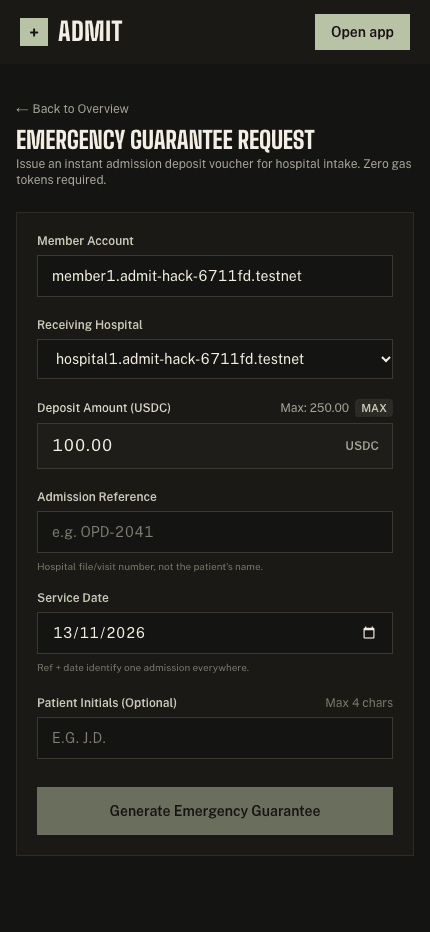
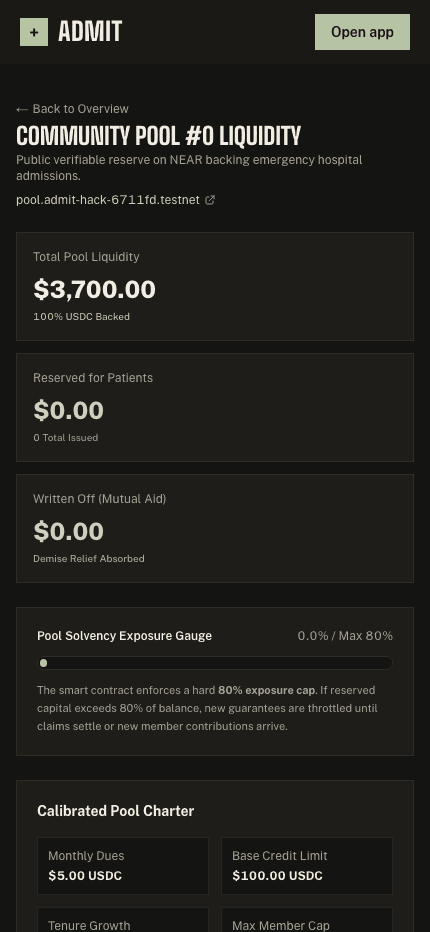
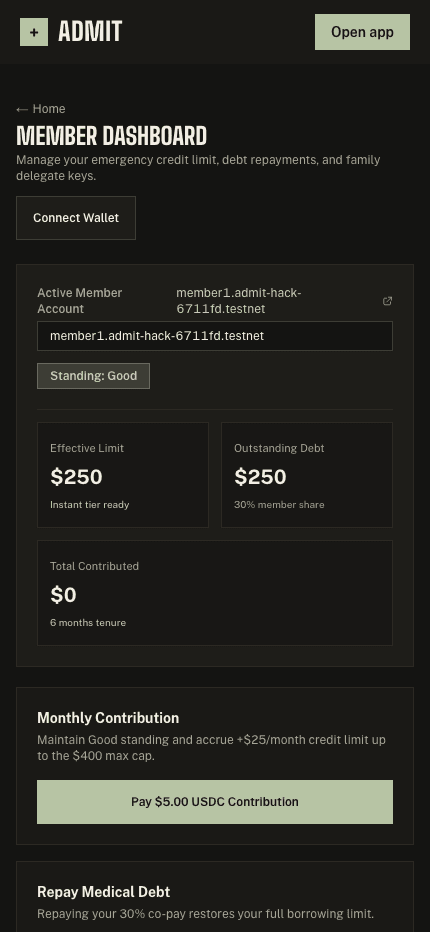
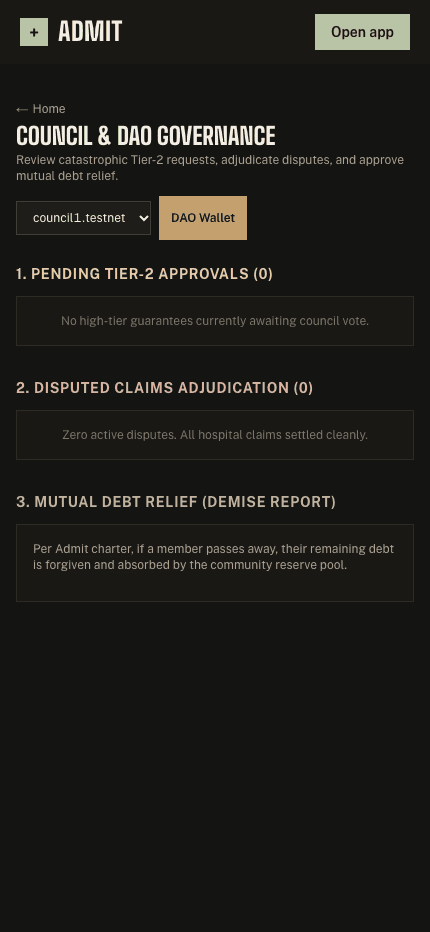
- 174
- contract tests across the unit and sandbox suites
- 10,000
- Monte Carlo runs per scenario, each over 24 months
- 0.00%
- probability of insolvency in normal, bad-year, and exit-wave conditions
- Normal
- Bad year
- Exit wave
The reserve survives a bad year and an exit wave.
At month 12 the exit-wave scenario pulls 35% of members out at once. The balance drops, then recovers. It never reaches zero. The exposure cap and the notice period do the work.
Read the simulationContract pool.admit-hack-6711fd.testnet on NEAR testnet. The source is MIT-licensed.
What is actually tested.
The evidence is a test suite and a simulation, not a pitch deck. These are the parts that are exercised on every run.
The contract
- 174 unit and
near-workspacestests for limits, exposure, tiers, expiry, claims, disputes, settlement, exits, and write-offs. - Every denial path has an error code: tenure, unpaid contributions, active cap, cooldown, default, exposure, tier.
- A failed token transfer rolls the state back; payment goes only to the registered hospital account.
- DAO-only methods, the relayer allow-list, and the hospital storage deposit are covered.
The clients and scripts
- 25 core tests for schemas, contract calls, hashing, delegates, and formatting.
- 26 API tests for the relayer allow-list, signature checks, and rate limits.
- 20 web tests for the code check, status banner, QR, countdown, and top-up UI.
- 28 script tests for the demo, seed helpers, and the simulator.
273 tests in total: 174 contract, 25 core, 26 API, 20 web, 28 scripts. The web, core, and API suites are listed in the README and run with pnpm test.
How the simulation works.
The solvency chart is not a forecast of returns. It is a stress test of the reserve under three scenarios, repeated 10,000 times per scenario.
What the model varies
- 10,000 runs per scenario, each over a 24-month horizon.
- Members join, contribute monthly, and occasionally need emergency care.
- Bills are drawn from a lognormal distribution; some members default.
- The exit wave pulls 35% of members out at month 12; the bad year raises emergency frequency, bill size, and default rate.
What stays fixed
- The circle’s parameters and the 80% exposure cap.
- The council tier, the 14-day dispute window, and the 7-day expiry.
- The solvency criterion: P(insolvent) must stay below 5%.
- The result is the probability that the pool cannot cover its reservations, not the return to any member.
All three scenarios finish above zero. In the bad year, 0.03% of guarantees are denied by the cap; insolvency is 0.00% in every scenario. The cap does the work: the pool throttles new guarantees instead of promising money it does not hold.
What this does not prove.
A testnet prototype is not a licensed financial institution. The limits are part of the design, not a footnote.
Is this audited?
No formal third-party security audit is included. The test suite and simulation are evidence, not an audit. A mainnet deployment needs an independent review and legal structuring first.
Does this prove hospitals will adopt it?
No. The registry is a testnet demo. Real adoption depends on clinics choosing to participate, local payment rails, and the legal structure of the circle.
Is this an investment?
No. Admit is a mutual-aid credit line. Members contribute to a shared reserve and repay their own share; there is no yield, no interest, and no tradable claim on the pool.
Is the AI review the final decision?
No. It is advisory. It checks line items against cited public tariff references, and a council member makes the settlement decision. It is not medical advice.
What about fiat?
The contract settles in USDC. Hospitals disburse in local fiat through licensed payment rails or P2P off-ramps; that dependency is documented in the README.
Is it live?
The portals read the live testnet pool, and requests from a paired device are relayed on testnet with the relayer paying the gas. Nothing here touches mainnet or real funds.